Loading page
Historical Research · Succeeded byNeurothena →
Project Athena
Pioneering a Genuine Cognitive Architecture Through Latent-Space Reasoning and Applied Cognition
Project Athena was Cogniscience Labs' foundational research into applied cognition — where core principles from psychology and neuroscience are not just metaphors, but the architectural blueprint. We engineered an AI that reasons, remembers, and learns in a way that is functionally analogous to the human mind. Its lessons became the foundation of Neurothena.
The Pillars of True Cognition
Beyond brute-force scaling. Athena was engineered around three principles that prioritize emergent, flexible, and efficient intelligence.
Deep Reasoning, Not Just More Words
Adaptive computational depth at inference enables dual-process reasoning — fast "System 1" and deliberate "System 2" — aligning with Kahneman (2011) and recent Test-Time Scaling methods (Geiping et al., 2025).
A Mind That Learns From Experience
The Tripartite Memory System means knowledge is earned over time, not pre-loaded. Episodic, Semantic, and Procedural memory work together to build genuine understanding from lived experience.
Grounded in a High-Fidelity World
Embodied Cognition — Athena learns cause-and-effect by acting within the Genesis physics simulator as a full-featured humanoid. Physical feedback loops directly into policy updates.
The Tripartite Memory System
Knowledge earned over time, not pre-loaded. Three memory types working in concert to build genuine understanding.
The Perceptual Archive
Episodic Memory
Records timestamped episodes of sensory inputs and actions, grounding knowledge in real experiences.
The Emergent Knowledge Graph
Semantic Memory
Autonomously distills abstractions and relationships from raw experience, forming a dynamic knowledge graph.
Embodied Skill Learning
Procedural Memory
Refines skills from successful action sequences — mastery through practice, not instruction.
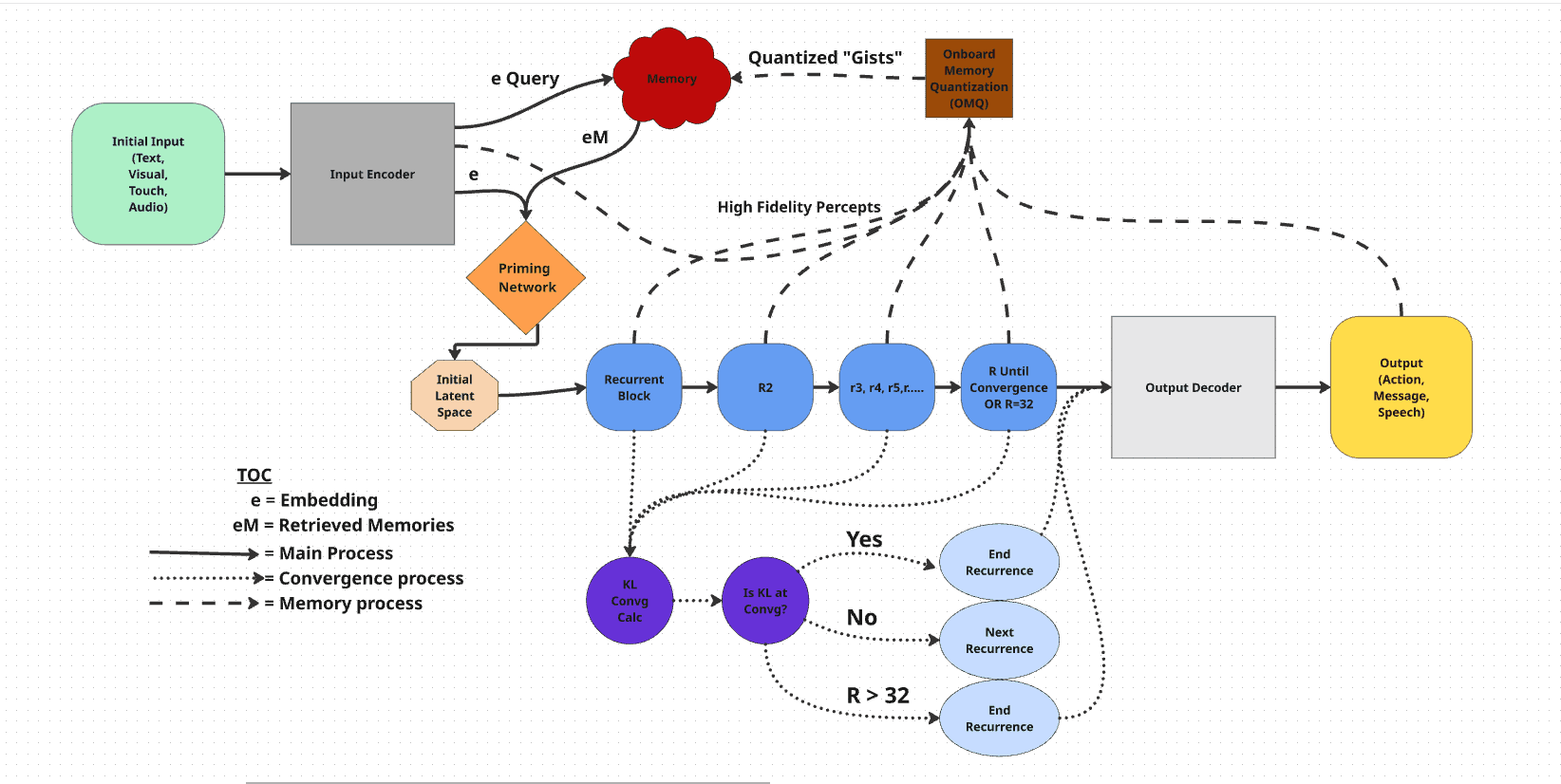
The Cognitive Flow: Perception → Reasoning → Action
Athena's architecture is a streamlined pipeline. Sensory inputs are fused in the Prelude Block, the latent thought-state is iteratively refined to convergence in the RecurrentDepthBlock, then translated into motor commands or communication by the CodaBlock.
Key Cognitive Mechanisms
From Perfect Recall to "Gist-Like" Memory
Onboard Memory Quantization (OMQ)
All experiential data is intentionally compressed into efficient 8-bit integer representations before storage. This lossy quantization forces the model to retain only the most salient features — a computational analog of human gist-based memory.
The Emergence of Abstraction
Concept Splitting
When a concept absorbs too much diversity, Athena automatically splits it using clustering (KMeans) to form more specific child concepts. Over time this yields a rich, hierarchical Emergent Knowledge Graph.
A Model of Subjective Cognition
Diffusion as Thought Formation
Reasoning begins from a noisy latent state — an indistinct intuition — and iteratively denoises it guided by diffusion principles (Ho et al., 2020) until a clear, converged thought emerges. Initial randomness encodes subjective starting points and supports genuine emergence.
Status & Legacy
Project Athena validated the foundational ideas behind applied cognition — diffusion-based reasoning, tripartite memory, and embodied learning in Genesis. Those insights directly shaped Neurothena's backprop-free cognitive stack. Athena is no longer under active development, but stands as the research foundation everything else is built on.
Gratitude to Unitree Robotics
We extend our thanks to Unitree Robotics for making the Unitree G1 humanoid platform publicly accessible. All credit for the robotics model showcased in Project Athena belongs to Unitree; our work focuses on the cognitive architecture layered atop their incredible hardware.
Interested in Our Research?
Athena laid the groundwork. Neurothena is where the research is heading next.