Loading page
Active Research
Neurothena
A Backprop-Free Cognitive System Built on Hebbian Plasticity and Biological Learning Principles
Neurothena is the evolution of Project Athena — a research-first, neuro-aligned cognition system that replaces gradient descent with pure local learning rules. Every concept is born organically through neurogenesis. Every synapse strengthens through repetition. No backpropagation. No loss functions. Just neurons, plasticity, and emergent intelligence.
Why Backprop-Free?
Biological brains don't compute gradients. They learn through local signals — neurons that fire together wire together. Neurothena takes this literally: every learning rule is local, online, and biologically plausible.
Hebbian/STDP Learning — Synaptic weights update based on temporal co-activation, not error gradients propagated backwards through layers.
Online Learning — No batches, no epochs, no training/inference split. The system learns continuously from each experience, exactly like a biological organism.
Pure Neurogenesis — Concepts aren't pre-allocated. Every neuron is born organically when the system encounters genuine novelty — like a developing brain forming new neural assemblies.
Dual-Process Architecture
Aligned with Kahneman's System 1 / System 2 framework:
System 2 — Thinking
ThoughtEngine: a recurrent settling system guided by distributed internal evidence signals like readiness, uncertainty, stability, confidence margin, and unknown pressure — not a single KL cutoff.
System 1 — Acting
MotorCortex: graph-based replay engine where high-level concepts drive concrete motor actions via vertical grounding.
Architecture Diagram
The full Neurothena cognitive pipeline — from sensory input through reasoning to motor output.
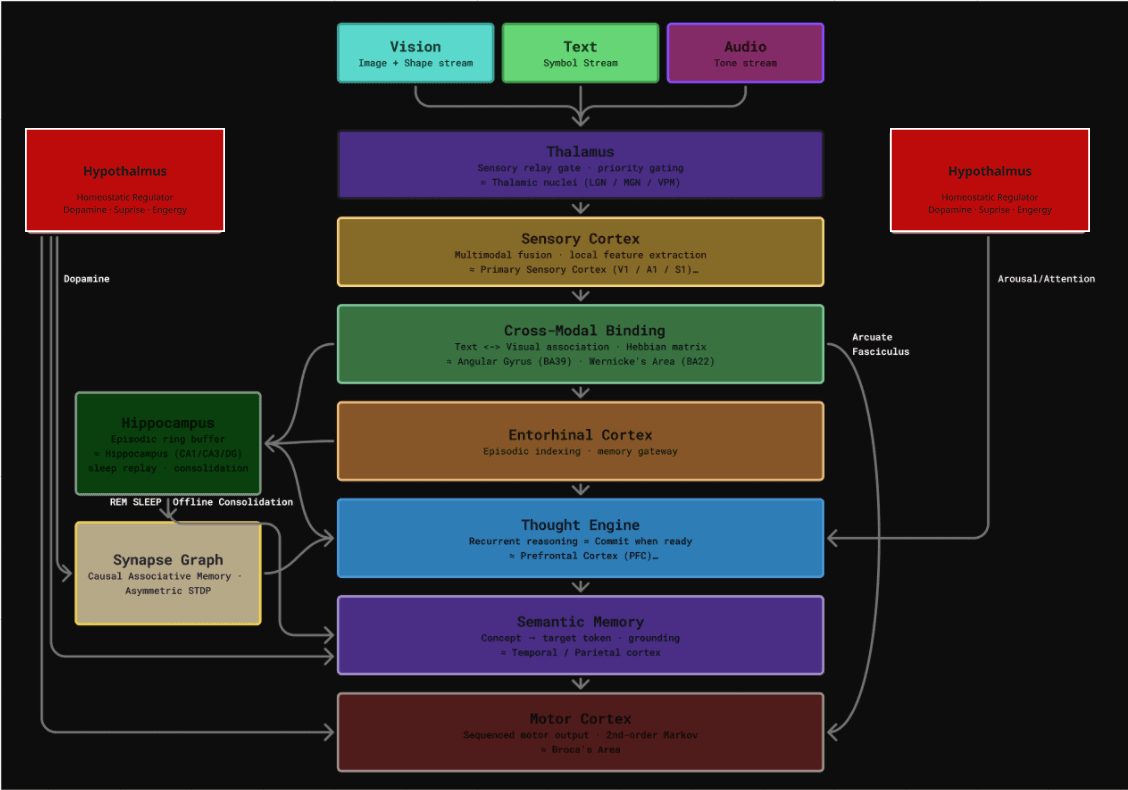
The Cognitive Stack
Seven pipeline layers plus three modulatory systems — each maps to a biological brain structure.
1
Thalamus
Sensory Relay Gate
Priority gating for multimodal input streams — filters and routes text, vision, and audio like thalamic nuclei (LGN/MGN/VPM).
2
Sensory Cortex
Multimodal Fusion
Local feature extraction across hierarchical layers — V1 Gabor → V2 edges → V4 shapes → IT identity, learned via Sanger's rule and lateral inhibition.
3
Cross-Modal Binding
Hebbian Matrix
Text↔visual association via Hebbian co-activation. Angular gyrus analogue — binds written symbols to visual features learned in different cortical columns.
4
Entorhinal Cortex
Memory Gateway
Episodic indexing and memory routing — the hippocampal funnel that gates which experiences enter long-term associative storage.
5
Thought Engine
Prefrontal Cortex (PFC)
Recurrent attractor network with distributed settling controller. Readiness, uncertainty, stability, and unknown-pressure signals guide when to commit vs. keep thinking.
6
Semantic Memory
Concept Grounding
Concept→token mapping via a context matrix. Links abstract system states to grounded language tokens for communication.
7
Motor Cortex
Sequenced Output
Graph-based motor replay engine (SequenceCortex). High-level concepts drive concrete output via vertical grounding — ideas become actions.
Modulatory Systems
Three supporting systems that regulate and ground the main pipeline.
Hypothalamus
Homeostatic Regulator · Internal World Model
Predictive coding engine that models expected states. Produces dopamine (prediction match), surprise (prediction error), and energy/fatigue signals that modulate all other systems.
Hippocampus
Episodic Buffer · External World Model
Ring buffer of recent experiences with diverse replay. Sleep consolidation replays and reinforces learned associations during offline periods.
Synapse Graph
Causal Memory
Directed graph of asymmetric STDP edges. Learns temporal cause-and-effect sequences — "fire" → "smoke" — not just symmetric co-activation. Persisted to SQLite.
Research Progress
~100%
Consistent accuracy on text and ASCII recognition via pure Hebbian learning
Active
Vision frontier — Sanger cortical columns, cross-modal binding, and active scene inspection
0
Backpropagation operations — fully local learning
Current Capabilities
Text Mastery — The text pathway reliably recognizes, sequences, and reproduces full character sets via Hebbian plasticity, asymmetric STDP, and the distributed settling controller.
Visual Cortical Columns — V1 (frozen Gabor) → V2 → V4 → IT learned entirely through Sanger's Rule (Generalized Hebbian Algorithm) and Földiák lateral inhibition. Active frontier: visual discrimination, cross-modal binding quality, and routing specificity.
Competency-Based Curriculum — Self-paced learning through Letters → Words → Stream phases. The system must achieve true mastery before advancing — no shortcuts.
Distributed Settling Controller — Recurrent thought governed by readiness, stability, uncertainty, unknown-pressure, and confidence margin — a multi-scalar halting signal more grounded than a single threshold.
MRI-Style Brain Dashboard — Real-time WebSocket visualization of neural firing, dopamine/surprise dynamics, the 3D synapse force graph, calcium tracks, STDP events, and cross-modal binding matrix.
The Vision Frontier
Sanger PCA at Every Layer — Each visual layer (V1→V2→V4→proj) independently discovers discriminative directions through local, unsupervised PCA. No gradient signal flows through the backbone.
Földiák Lateral Inhibition — Anti-Hebbian competition matrices at V4 and IT prevent feature collapse, enforcing specialization between cortical columns that process confusable characters.
Micro→Macro Concept Hierarchy — Fine-grained micro-concepts capture handwriting variants; a temporal co-activation process groups them into macro-concepts for cross-modal binding.
Active Scene Inspection (Planned) — Peripheral awareness → foveal fixation sequence → scene memory with uncertainty-based decay. The developmental path: isolated symbols → symbols in clutter → multi-region pages → live video stream.
Audio Modality (Future) — A third cortical column for auditory processing. Audio learns independently and binds to text/vision through the same Hebbian co-occurrence mechanism.
Evolution from Project Athena
Project Athena explored diffusion-based cognitive architecture with embodied cognition in the Genesis physics simulator. That research revealed a fundamental insight: real intelligence doesn't need backpropagation. Neurothena carries Athena's core philosophy forward — applied cognition, tripartite memory, dual-process reasoning — but rebuilds the foundation on biologically plausible Hebbian learning.
Read about Project Athena's foundational research →Interested in Neurothena?
Follow our research journey or explore how our cognitive AI expertise can benefit your organization.